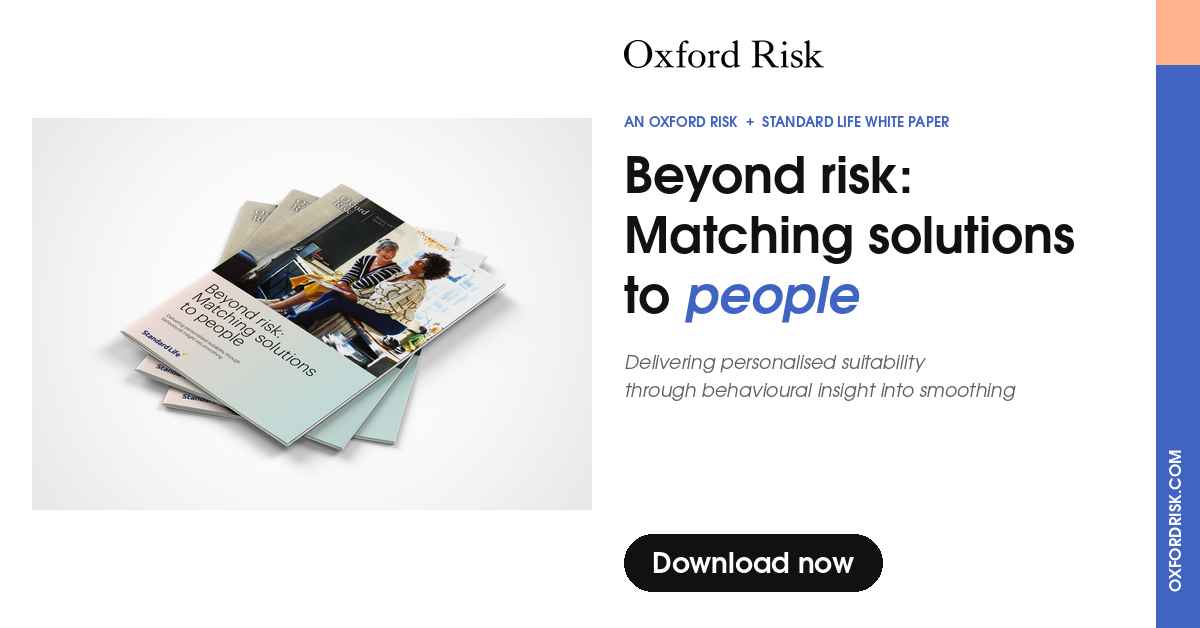
Leading behavioural finance firm, Oxford Risk,and Standard Life, a retirement specialist focused entirely on retirementsavings and income, today publish a joint white paper titled, Beyond Risk:Matching Solutions to People.
The paper argues that traditional risk profiling is not enough: advisers and providers also need to understand how investors are likely to respond emotionally to volatility, and which solutions they can realistically stay with over time.
The white paper arrives at a pivotal moment for financial advisers and their clients. With markets continuing to experience periods of heightened uncertainty, and the FCA's Consumer Duty placing greater emphasis on demonstrating genuine client benefit, the need to understand the full picture of an investor's emotional as well as financial circumstances has never been more pressing.
The Hidden Cost of Ignoring Investor Behaviour
According to the white paper, most investors fall short of their long-term goals not because they lack financial knowledge, but because they struggle to maintain their investment strategy in the face of emotional discomfort. When markets fall, many investors panic and sell. When markets rise, they chase performance. Over time, this behavioural gap between good intentions and real-world actions leads to costly deviations from suitable long-term investment plans.
The paper highlights the importance of Behavioural Capacity: an investor’s emotional ability to stay invested through volatility. This complements traditional measures of willingness and financial ability to take risk by showing whether an investor can realistically live with the journey their portfolio may take.
Traditional portfolio construction has long been centred on risk-adjusted returns, often operating on the assumption that investors are emotionally neutral and capable of withstanding volatility. But investors are not robots. They experience fear, regret, uncertainty, and doubt. Failing to account for these behaviours and the emotional responses they trigger means that even the most technically optimised portfolio can fall short if the investor cannot stick with it.
The paper introduces ‘anxiety-adjusted returns’ as a practical lens for understanding the outcomes investors can realistically achieve once the emotional costs of the investment journey are taken into account. Rather than simply maximising expected returns, advisers and providers should focus on building portfolios that investors can confidently maintain through periods of market turbulence. This delivers not just financial performance, but confidence and peace of mind.
Dr Greg Davies, Head of Behavioural Finance at Oxford Risk, explains:
"Suitability is not just about the risk an investor can afford financially; it is about the journey they can endure emotionally. Too often, those two things are treated as the same, and they are not. A technically optimised portfolio can still fail if the investor cannot live with the journey. Our behavioural fit to smoothing framework helps advisers identify where volatility is likely to become behaviourally costly, and where smoothing can provide useful emotional support. The goal is not to eliminate volatility. It is to help investors stay with a suitable long-term strategy in good times and bad."
Smoothing as a Tool for Emotional Resilience
Central to the white paper is an examination of investment smoothing. It is designed to reduce the visible peaks and troughs of portfolio values as markets move. The paper makes clear that smoothing is not a universal solution; for some investors, it offers a valuable buffer against the anxiety of volatility, while for others it may add unnecessary cost or complexity without meaningful benefit. The central point is not that smoothing is inherently better, but that it should be matched to the right investors, in the right context, for the right behavioural reasons.
The key, Oxford Risk and Standard Life argue, is understanding who is most likely to benefit and why. This requires going beyond demographics or a single risk score to consider an investor's deeper behavioural traits: their composure under stress, their tendency towards impulsive decision-making, and their sense of financial security. It also requires adviser-led contextual judgement, including how dependent the client is on the portfolio, whether withdrawals are being taken, how close key spending goals are, how visible the portfolio is, and whether life events are making market movements feel more emotionally salient.
Commenting on the launch of the white paper, Mark Baldwin, Head of Smoothed Managed Funds at Standard Life, said:
“Taking a long-term view of investing requires understanding what causes investors to come off track, and volatility is one of the biggest threats to long-term outcomes because of how it can affect investor behaviour. Today’s white paper explores this further, highlighting that when people feel more confident through periods of uncertainty, they’re more likely to make good decisions and remain invested over the long term.
“In this context, smoothed funds can play an important role in helping investors stay the course. By stabilising portfolio values during volatile periods, they can provide the reassurance needed to remain committed to a long-term strategy and improve outcomes.
“This thinking is exemplified by Standard Life’s smoothed fund range, designed not simply as an investment fund, but as a tool to support better investor behaviour. Through our work with Oxford Risk, we aim to highlight the importance of matching solutions to the whole person, considering not just financial needs, but how investors are likely to respond in practice.”
Please click here to download the white paper now, Beyond Risk: Matching Solutions to People.